Pale Ale vs IPA: A Practical Style Comparison
- What is the difference between pale ale and IPA?
- Which numbers actually overlap?
- What sensory differences matter beyond the figures?
- Where do West Coast, Hazy, Session, and Double fit?
- Why does IBU not measure how bitter every beer tastes?
- How can you compare labels without tasting anything?
- How does serving size change the alcohol comparison?
- Can color, haze, or age settle the style?
- If you choose to taste, what should you record?
- What changes when you are comparing homebrew recipes?
- Sources
What is the difference between pale ale and IPA?
American pale ale generally gives supporting malt more room, while American IPA emphasizes hops, bitterness, and a drier balance. Their alcohol and bitterness ranges overlap: neither number alone identifies the style. This comparison uses BJCP's 2021 American categories, not every commercial beer carrying either name. It is desk research for adults of legal drinking age, not a tasting report. Alcohol is not a health product; never drive after drinking.
Both are ales. The distinction sits within that broad family, rather than separating ale from lager. Start with the producer's complete style description, then use the beer-style reference hub and the specific guideline that fits the comparison.
Which numbers actually overlap?
The Beer Judge Certification Program (BJCP) publishes these ranges for 18B American Pale Ale and 21A American IPA:
| Measure | American Pale Ale | American IPA | Shared interval, calculated here |
|---|---|---|---|
| Original gravity, OG | 1.045–1.060 | 1.056–1.070 | 1.056–1.060 |
| Final gravity, FG | 1.010–1.015 | 1.008–1.014 | 1.010–1.014 |
| Bitterness, IBU | 30–50 | 40–70 | 40–50 |
| Color, SRM | 5–10 | 6–14 | 6–10 |
| Alcohol, ABV | 4.5–6.2% | 5.5–7.5% | 5.5–6.2% |
OG and FG are specific-gravity readings before and after fermentation. IBU means International Bitterness Units; SRM is a beer-color scale; ABV means alcohol by volume. These are competition reference ranges, not rules compelling every producer to use the same commercial label.
Each shared interval takes the higher lower boundary and the lower upper boundary. For example, the original-gravity overlap starts at 1.056, not 1.045, and ends at 1.060, not 1.070. Every row overlaps. That is why collecting more numbers is useful context but not a mechanical style verdict.
Keep the established example: two beers can both be 6% ABV and 45 IBU. Both figures fit both columns. Likewise, a pale ale at 50 IBU and an IPA at 40 IBU can fit their respective ranges. Do not silently turn “usually” into “every beer.”
What sensory differences matter beyond the figures?
Within those named guidelines, pale ale has moderate–moderately-high hop aroma and moderate–high bitterness. Low–moderate neutral or grainy malt supports it; restrained bread, toast, biscuit, or caramel notes can fit. IPA has prominent–intense hop aroma, medium–very-high hop flavor, and medium-high–very-high bitterness, with lower supporting malt and a dry–medium-dry finish. Neither requires harshness or astringency.
American/New World hop vocabulary includes citrus, floral, pine, resin, spice, tropical fruit, stone fruit, berry, and melon. No descriptor is mandatory. Grapefruit-like aroma does not establish that grapefruit was added: read the ingredient information or ask the producer.
Pick a question before comparing: are you choosing between two listed products, or trying to understand a producer's style wording? Those are different tasks, and neither requires ranking the styles by quality. Burning, vegetal, or rough/astringent character should not be excused just because a label promises intensity. Comparing similarly brewed pale ales with different named hops can also focus attention on variety differences, but it is not a controlled experiment unless the other variables really match.
For recipe interpretation, a clean pale base and restrained specialty malt support either style. Excess caramel can clash with hops; an overly thin base may leave bitterness unsupported. Treat malt–hop balance as a recipe decision, not just a hopping-rate adjustment. Modern pale ale sometimes resembles a lower-gravity IPA, as 18B notes. That does not make it an inferior beer.
Where do West Coast, Hazy, Session, and Double fit?
BJCP 21A includes dry, sharply bitter, clear West Coast examples within American IPA.
Other names need different references:
- 21B Specialty IPA accommodates session-strength American IPA. Session is a lower-strength variation, not proof that every IPA exceeds every pale ale's ABV.
- 21C Hazy IPA has its own fuller, softer, fruit-forward balance and appearance expectations. It is also called New England IPA or NEIPA.
- 22A Double IPA is the stronger category, rather than the default meaning of American IPA.
Producer usage still varies. Ask which description the producer intends instead of treating these names as interchangeable or assuming a particular strength from a coastline. A modifier belongs in your notes exactly as printed; a missing modifier should remain missing.
Why does IBU not measure how bitter every beer tastes?
BJCP's hops reference describes IBU in terms of isomerized alpha acids in finished beer. It also explains why water chemistry and attenuation affect perceived bitterness. The number is not a linear sensory score: twice the IBU does not establish twice the perceived bitterness.
Malt sweetness and final gravity belong in the comparison, but so do hop character, carbonation, alcohol warmth, serving temperature, and the individual's sensitivity when describing the whole sensory impression. Keep those observations separate from a laboratory bitterness measurement. A lower FG may support a drier impression; it cannot classify the style by itself.
Dry hopping can add aroma to either beer. Variety, amount, timing, and process matter; neither of these two categories universally requires that operation. Likewise, a recipe's calculated IBU is not automatically a measured finished-beer result. Use one calculation model consistently when comparing recipes because utilization varies with the brewing process.
How can you compare labels without tasting anything?
Use this original record with a package, tap list, or producer's current product page. No purchase, opening, or drinking is required.
| Field | What to record | What not to infer |
|---|---|---|
| Identity | Exact beer name, producer, and style wording | That “IPA” always means 21A |
| Strength | Printed ABV and actual stated container or pour volume | Strength from color or smoothness |
| Bitterness evidence | Published IBU, including whether its basis is stated | Zero IBU when no number is provided |
| Description | Producer's aroma, malt, finish, and body terms | Personal tasting findings you have not made |
| Condition | Date code, its meaning, storage instructions | Freshness solely from clarity |
| Open question | One specific missing fact to ask the producer | A guessed answer copied from another beer |
For the hypothetical 6%/45-IBU pair, enter those values but leave unknown OG and FG blank. If one description says “pale ale” and the other “American IPA,” retain both labels. Record which sensory information remains missing rather than declaring one mislabeled from the shared numbers.
A useful question would be: “Does this product's IPA description mean your standard American IPA, and do you publish its finish or body profile?” That asks for information. “Your IBU proves this is pale ale” claims a conclusion the evidence does not support.
How does serving size change the alcohol comparison?
Read ABV and volume together. Here is the pint comparison made explicit using US fluid ounces, not an imperial pint:
| Illustrative serving | Pure-alcohol calculation | Pure-alcohol volume |
|---|---|---|
| 16-US-fluid-ounce pint at 7% ABV | 16 × 0.07 | 1.12 US fl oz |
| 12-US-fluid-ounce pour at 5% ABV | 12 × 0.05 | 0.60 US fl oz |
The first contains 1.12 ÷ 0.60 = about 1.87 times the pure alcohol in the second. NIAAA defines a US standard drink as about 0.6 fluid ounces or 14 grams of pure alcohol. These examples therefore represent about 1.87 and 1 US standard drinks respectively—not safe-consumption allowances.
This is arithmetic, not a personal blood-alcohol estimate. Flavor intensity, smoothness, and perceived effects cannot clear anyone to drive. NHTSA advises arranging a sober ride before drinking. Follow medical advice to avoid alcohol; choosing either style confers no health benefit.
Can color, haze, or age settle the style?
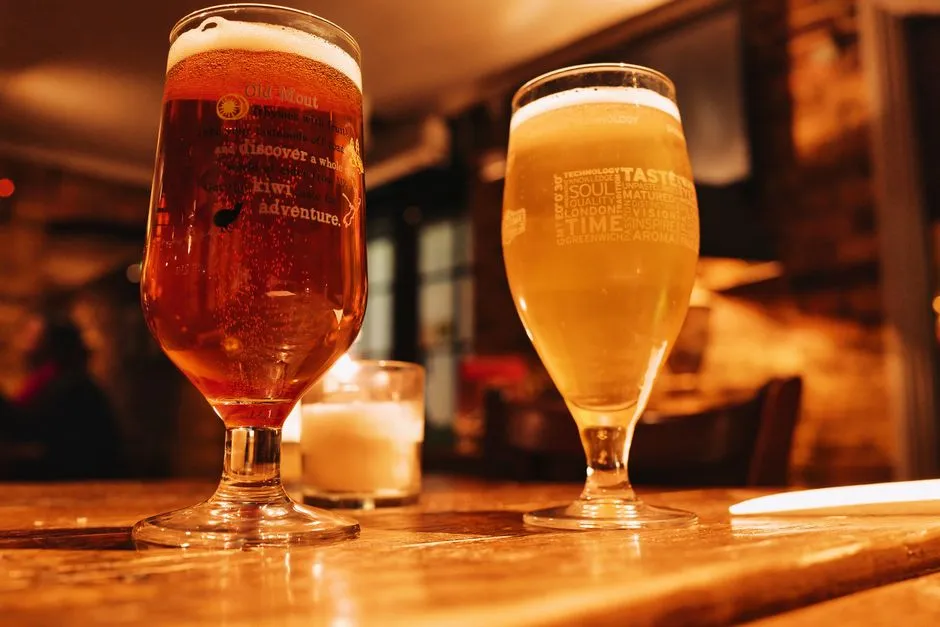
No. The color ranges overlap from gold into light amber. A photograph also introduces lighting differences; darker color may reflect malt choice or a specialty variation. Oxidation can darken beer too, as the CraftBeer.com course explains on page 66. Appearance alone cannot identify which explanation applies.
Keep the guideline wording distinct: 18B expects generally quite clear beer; 21A expressly allows light haze. Do not apply the latter allowance to both as though the descriptions were identical. A Hazy IPA should be considered using its own profile, not diagnosed from cloudiness alone.
Yeast, proteins, hop polyphenols, dry hopping, and processing can contribute different kinds of haze. The Brewers Association quality guide distinguishes physical changes from microbiological contamination. Intended haze, incomplete clarification, and handling problems are not interchangeable explanations. Clear beer can still be oxidized, contaminated, or unbalanced; cloudiness is not a safety test either.
Oxygen, heat, and time can reduce hop aroma, mute fruit, diminish bitterness, and introduce stale sweetness or paper/cardboard notes. Light-struck skunkiness is a separate mechanism. Pale ale changes too; fading might be less conspicuous where hops were initially less dominant, but that is not evidence of a longer shelf life.
Check packaged-on or best-before information, confirm what an unfamiliar code means, and follow producer storage guidance. Choose retailers with sensible stock rotation; keep beer cool and dark. Cans exclude light but do not prevent heat- or time-related change. These are freshness observations, not permission to taste questionable beer to establish safety.
If you choose to taste, what should you record?
Tasting is optional and only for adults of legal drinking age. Use modest, equal volumes in similarly shaped, clean, odor-free glasses with room for the head. Avoid frozen mugs and any glass carrying ice, freezer odors, or detergent residue. Follow producer serving guidance: excessive cold can mute aroma, while warmth changes the perception of alcohol and sweetness.
Our short note order is:
- Aroma: intensity and recognizable hop families.
- Malt: neutral, grainy, bread, toast, biscuit, or light caramel impressions.
- Balance: shared emphasis or hops dominating.
- Finish: dryness, lingering bitterness, and any harshness.
- Body and carbonation: texture and whether sharpness dominates.
Smell before tasting and note changes as the sample's temperature changes. Begin with the lower-intensity or lower-ABV sample when known. The BJCP judging manual supports aroma-first evaluation, reassessment, and water with plain bread or unsalted crackers between entries. This small record is not its competition scoresheet.
The CraftBeer.com course allows spitting rather than swallowing. That avoids swallowing that sample; it does not establish zero exposure or fitness to drive. You never need to finish either pour. Stop drinking if you notice effects, but do not wait for noticeable effects to arrange sober transportation or use self-assessment to decide whether to drive.
What changes when you are comparing homebrew recipes?
Use the ranges as a design reference for original gravity, final gravity, hop additions, malt support, and the desired balance—not a complete recipe. Keeping a clean fermentation base consistent can help isolate intended recipe differences on paper. Our dry versus liquid malt extract comparison explains why ingredient form and quantity also need an explicit basis.
Clean and appropriately sanitize cold-side equipment, and control unwanted oxygen exposure after fermentation. Follow product directions, equipment manuals, and a complete validated process; consult a qualified brewer when uncertain.
For bottle conditioning, actual beer volume and target carbonation matter to a priming calculation, but are not enough by themselves. The Brewers Association's package-pressure guidance requires attention to completed fermentation, priming additions, package pressure limits, and unintended refermentation, which can rupture packaging. This style comparison is not a bottling procedure or permission to improvise pressure handling. Neither pale ale nor IPA naming changes those safeguards.
Sources
- BJCP 2021: American Pale Ale 18B and American IPA 21A.
- BJCP 2021: Specialty IPA 21B, Hazy IPA 21C, and Double IPA 22A.
- BJCP: Hops study guide and Judge Procedures Manual.
- Brewers Association: Quality Craft Beer guide, especially pages 5–8 and 11–13; package over-pressurization.
- CraftBeer.com: Beer & Food Course, pages 34, 36, and 66.
- NIAAA: US standard drink definition. NHTSA: Drunk driving and sober transportation.